
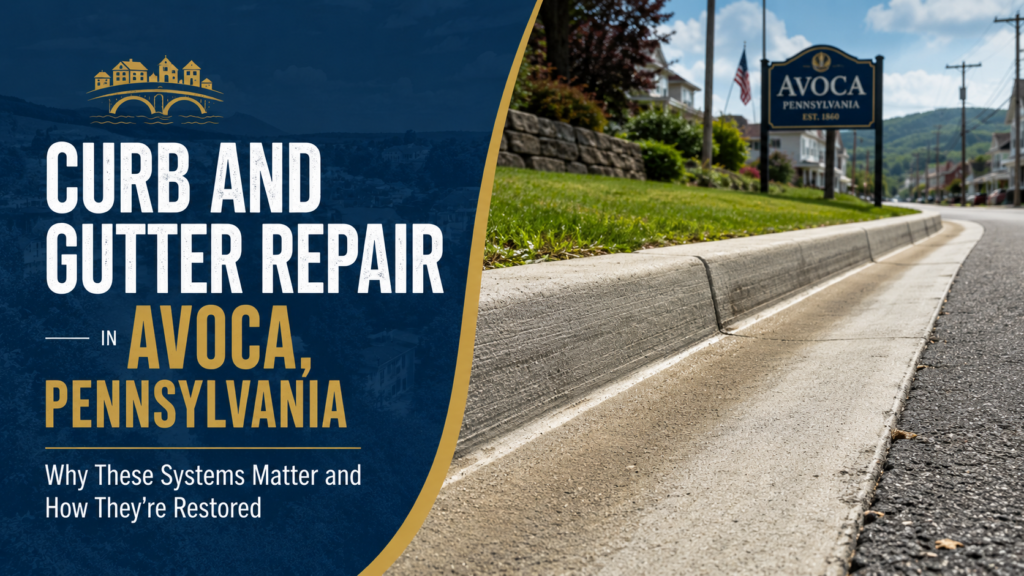
Curbs and gutters are among the most overlooked components of a well-functioning property, yet they perform essential roles in protecting paved surfaces, managing stormwater, and maintaining safe conditions for vehicles and pedestrians. In Avoca, Pennsylvania where Northeastern Pennsylvania’s harsh winters, freeze-thaw cycling, and heavy precipitation test infrastructure constantly maintaining functional Curb and Gutter Repair Avoca systems is a critical aspect of pavement and site maintenance for both residential and commercial properties.
What Curbs and Gutters Actually Do
While they are often thought of simply as the raised concrete edge along a street or parking area, curbs and gutters serve multiple interconnected functions:
- Stormwater management: Gutters the low channel at the base of a curb intercept surface water runoff from paved areas and channel it toward catch basins, inlets, or designed drainage outlets. Without this guidance, water disperses across pavement surfaces, saturates base materials, and accelerates asphalt deterioration.
- Pavement edge support: Curbs provide lateral confinement to asphalt pavement. Asphalt at the pavement edge, without curb support, gradually migrates outward under traffic loads a process called edge crumbling or raveling. Intact curbs maintain the pavement structure’s lateral stability.
- Traffic and pedestrian guidance: Curbs physically define driving lanes, parking areas, and pedestrian zones. They prevent vehicle encroachment into landscaped or pedestrian areas and provide positive physical guidance to drivers.
- Foundation protection: By directing runoff away from buildings and structures, properly functioning gutter systems reduce the water load applied to foundations a critical protective function in Avoca’s climate where foundation moisture issues are common in older properties.
How Avoca’s Climate Damages Curbs and Gutters
Northeastern Pennsylvania’s climate creates specific damage mechanisms for concrete curb and gutter systems:
- Freeze-thaw spalling: Water infiltrates micro-cracks in concrete, freezes, expands, and breaks off surface layers (spalls). Repeated over many cycles, this process progressively weakens the concrete, exposing aggregate and creating rough, irregular surfaces.
- Salt deterioration: Road salt applied for winter ice control accelerates the freeze-thaw damage mechanism and introduces chloride ions that attack the steel reinforcing bars (rebar) within the concrete. Rebar corrosion causes expansive cracking and ultimately structural failure of the concrete section.
- Root intrusion: Tree roots growing beneath curb sections can generate enough force to lift, crack, and displace concrete. In established residential neighborhoods of Avoca, tree roots are a common cause of curb displacement.
- Vehicle impact: Vehicles driving over or striking curbs generate impact loads that crack and displace concrete sections, particularly at corners and low points where encroachment is most common.
- Settlement and undermining: Inadequate base preparation, eroded sub-base material beneath the curb, or void formation from drainage leaks can cause curb sections to settle unevenly, disrupting the drainage gradient.
Types of Curb and Gutter Repair
Curb and gutter repair encompasses several different scope levels depending on the extent of damage:
- Joint sealing: Expansion joints and construction joints between curb sections can open over time, admitting water and accelerating deterioration. Cleaning and sealing these joints with appropriate flexible sealant is a preventive maintenance measure.
- Patching: Localized spalling or surface damage on otherwise sound concrete can be repaired with bonded concrete patch material. This is appropriate for surface damage that has not compromised the structural integrity of the section.
- Section replacement: When a curb section is cracked through, significantly displaced, or structurally compromised, the damaged section must be saw-cut from the adjacent sections and entirely replaced. The new concrete is cast-in-place using appropriate forms to match the existing curb profile.
- Full curb and gutter reconstruction: In areas where the entire curb and gutter system has failed or where the alignment and grade no longer function correctly, full removal and reconstruction is required.
The Repair Process for Concrete Curb and Gutter
For section replacement the most common significant curb repair the process involves:
- Saw cutting the damaged section’s boundaries cleanly, typically at existing joint locations where possible to minimize disruption to adjacent sections.
- Demolishing and removing the damaged section and any contaminated base material beneath it.
- Preparing the sub-base replacing any degraded material with compacted aggregate to restore proper bearing and drainage.
- Installing formwork matching the existing curb profile precisely, including the correct reveal height, gutter channel dimensions, and any driveway approach transitions.
- Casting concrete meeting appropriate strength specifications for exterior pavement use in Pennsylvania’s climate typically 4,000 PSI minimum strength with air-entrainment for freeze-thaw resistance.
- Proper curing maintaining moisture and appropriate temperature conditions for a minimum of 7 days before the work is open to traffic.
The Relationship Between Curb Repair and Pavement Maintenance
Curb and gutter repair should be coordinated with broader pavement maintenance cycles. When asphalt resurfacing or overlay is planned for a parking lot or driveway, damaged curb sections should be repaired before the paving work, not after. Paving over or adjacent to damaged curbs locks in the problem and limits the ability to make repairs without damaging the new pavement surface.
Similarly, when curbs are being replaced, it is an appropriate time to evaluate the drainage function of the entire system catch basin condition, gutter slope adequacy, and outlet function so that all components of the stormwater management system are working together effectively after the repair work is complete.
Conclusion
Curb and gutter repair in Avoca is a concrete construction and drainage maintenance service that protects the entire pavement system it borders. Understanding the functional role these systems play, how Pennsylvania’s climate damages them, and what proper repair involves helps property owners recognize when intervention is needed and ensure that repair work is executed to the standard required for long-term performance in Northeastern Pennsylvania’s demanding environment.


